Tuesday, November 8, 2011

Interview with US U18 Coach Richie Williams

US Under-18 National Team Coach Richie Williams, was recently interviewed by Mike Woitalla of Soccer America.

Williams on what good youth players need to develop-

“When I’m working with the U-14s and U-15s, you see a lot of talented players,” Williams says. “Very skillful with good technique on the ball – dribbling, passing.

“I don’t know exactly when this happens, but when they start to get a little bit more mature and develop physically, you see them depending more on their physical abilities than their technical abilities. And that’s where you see sometimes the quality of their play decreasing because they’re relying more on their physical abilities.

“You have to have a balance. You can’t forget about your technical abilities. As these kids grow, you have send the message, 'Now that you’re physically fast or strong, don’t just rely on taking the ball and running past people. You still want to play the same way you did when you were younger. You weren’t developed physically then and you had to rely on your controlling the ball and your passing.'

“Encourage that. When kids are moving up the style of play is important and they have to continue developing their technique.”


Williams has been coached and coached with some of the biggest names in American soccer. His coach at the Union Lancers, who won two McGuire Cups, was Manny Schellscheidt, who has coached at all levels of the men’s national team program and served as U-14 national identification program head from 1998 until last month. Bob Bradley was Schellscheidt’s assistant with the Lancers.

Arena was Williams’ coach at Virginia, where Williams and Reyna played on the 1991 NCAA championship team, and for three years at D.C. United, where Williams played alongside Marco Etcheverry on what many still consider MLS's greatest team ever. (Williams won two MLS Cups with United under Arena and one under Coach Thomas Rongen.)

Williams on becoming a successful coach-

“The successful coaches, same as a player, you have to be a hard worker, you have to be organized,” says Williams. “Obviously, you have to know the game. And you also have to be fair and honest with people.

“There’s tough decisions to be made sometimes, but as long as you’re upfront and honest about them you'll stay on the right track. You’re dealing with a lot of different personalities. Being able to understand each individual -- and not just expecting them to be exactly like you are, because you need guys from different places and with different personalities. You have to know how to man-manage these guys and understand how they do things might not be the same way you do things – but that’s OK as long as you get them to play within the group.

“And especially with the young players, you need to be patient and help them to be better soccer players in whatever way they need it.”

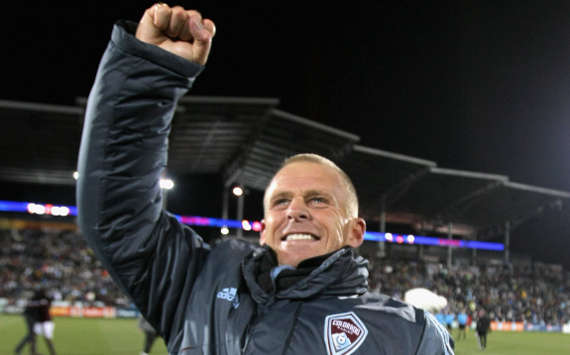
Gary Smith and Colorado part ways

Paul Kennedy of Soccer America reports that less than a year after he led the Colorado Rapids to their first MLS championship, Englishman Gary Smith is out as head coach.


Management announced on Monday that it will not renew Smith's contract, making his departure the second quickest forced exit of an MLS Cup champion coach in league history.

Steve Sampson, who led the Los Angeles Galaxy to its last MLS championship in 2005, was fired on June 6, 2006.

(Sigi Schmid quit as Columbus Crew after its MLS Cup 2008 title to become the Seattle Sounders head coach. Frank Yallop quit a year after leading the San Jose Earthquakes to their second league title in 2004 to become Canada's national team coach.)

Smith had a very public dispute with technical director Paul Bravo with whom he clashed over personnel matters as negotiations with Rapids managing director Jeff Plush on a new contract dragged on.

Smith, who joined the Colorado Rapids as an assistant coach in early 2008 before taking over as interim head coach from Fernando Clavijo for the final 11 matches of that season, told the Denver Post, "I've worked tirelessly under extreme duress at the club, I've gotten little to no help from Paul or from Jeff, and still managed to put a team together that won a championship and got in the playoffs this year. I feel as though I've been very disrespected in all of this."

He added that his recent remarks about his problems with Bravo stemmed from his frustration that the renewal of his contract was taking so long.

“After meeting with Gary, we decided it would be in the best interest of both parties to move in a different direction,” Plush said in a statement. “We’d like to thank Gary for his many contributions to the Colorado Rapids organization. He was instrumental in the Rapids winning our first-ever MLS Cup last year, and we wish him nothing but the best as he explores new opportunities.”

After stints as an assistant at several small English clubs Smith was working as a scout for Arsenal -- now owned by Rapids owner Stan Kroenke -- when he came to Colorado in 2008.

In his three-plus seasons in the role of head coach, Smith had a regular-season record of 39-31-35. In 2011, the Rapids went 12-9-13 and reached the quarterfinals of the MLS playoffs despite being ravaged by injuries.

They were eliminated from the Concacaf Champions League on the final day of the group stage. Earlier in the competition, with the Rapids struggling in MLS and Concacaf, Smith chose not to fly with the team to an away game in El Salvador. The move drew criticism from Schmid, whose Sounders were competing in another Concacaf group.

Monday, November 7, 2011

Be a problem-solver as a team leader/MIKE JACOBS COLUMN

Courtesy of the Evansville Courier Press, November 7, 2011


When it comes to developing young leaders, helping prepare youths how to deal with adversity is critical in that process.

The definition of adversity is a misfortune – a hardship and suffering, and is normally synonymous with harsh conditions or hard times.

Everyone will come across adversity during the course of their day at some point, but the special leaders are the ones that can problem solve when adversity strikes. You can normally group those dealing with adversity into two different parties – those who identify problems, and those who solve problems.

It’s easy to identify problems, and it usually includes the shirking of responsibility. Finger pointing and assessing blame can lead to finding who committed the infraction, but it doesn’t actually fix the problem. Problem identifiers usually lack self-confidence, and find it easier to point wrong-doing at someone else rather than either accept when they are part of the problem, or to actually look to fix the problem.

The problem solver is more of a unique personality, because they have to be selfless – worrying more about helping teammates (placing the group ahead of one’s self) and worrying less about how they look at the hands of defeat or a mistake.
It’s not easy to solve problems, but it’s critical to be able to do so to achieve success. Here are some keys to think about when developing problem solvers:

Pressure is self-imposed – we put it on ourselves, and those who are most confident and composed when faced with crisis are the ones who find success.
No age group challenges with dealing with pressures more than in middle school and high school. Whether it be to excel in sports, earn good grades or managing hectic schedules, it can certainly feel overwhelming at times. Talk to your children about how to solve these problems – create a plan of how to fix what’s wrong, and walk them through those steps. The same way teams may practice specific situations (practicing being up a goal/down a goal; practicing being up a player/down a player), if they are versed in how to react when those pressures arise, they will be able to cope much better.

Focus on the process – too often, players and coaches stress the idea of having to win more so than the process of getting better. When the primary challenge is to improve on a player’s performance or behavior, it’s easy to defer some of those external distractions that come along with winning or losing a game.
The reality is that the most successful athletes and coaches were too consumed with improving and getting better to be distracted with whether they won or not – in turn, they won more often than they lost because they focused on getting better each day. John Wooden never stressed the need to win in pre-game talks, but rather focusing on the things you have to do to win.

Stress resiliency – players who are resilient are able to recover quickly from setbacks. The best players focus on the process of getting better, and the best coaches develop players and leaders that have the ability to bounce back when things don’t go their way. Pele once said “Success isn’t determined by how many times you win, but by how you play the week after you lost.”

Not only should you place your players or children in adverse situations to see how they respond, but you should also praise them when they do rise in the face of adversity – true leaders are resilient and don’t let small setbacks deter them from their goal. A player who develops resolve can make themselves better, can solve problems, and will be able to bounce back when mistakes arise.

Leaders have foresight – Problem-solvers understand that the reason why a car’s windshield is significantly larger than the rear-view mirror is because what’s in front of you is a lot more important than what you’ve already passed. Stress to young athletes to not get too hung up on a previous mistake, but rather, move on by fixing the problem and learning from it. Even in defeat, a coachable moment can make the team or athlete better for the next game.

If you are looking for problem solvers on the field or court, you can usually identify them after a critical error happens – they’re the one with their arm around a teammate offering encouragement, or barking out orders to prevent a mistake from happening. Anyone can pass the blame onto someone else, but the true problem-solver prevents mistakes from happening, and then helps those around them learn and grow when a mistake does happen.

Challenge those around you to be a problem solver, opposed to a problem identifier – my guess is that if you can do that, you’ll end up winning in more ways than just on the scoreboard.

Whitecaps staff meshes together

After two successful seasons together in Carolina, Paul Ritchie knows what Martin Rennie is thinking, and when he’s thinking it.

That chemistry is now at the core of the Vancouver Whitecaps’ coaching staff. Ritchie was welcomed as Rennie’s first assistant on Thursday, the second day of an eight-day mini-camp at the Burnaby Lake Sports Complex.

“One thing I like with Paul is he’s very proactive,” said Rennie, who was announced as the Caps’ future coach on Aug. 9 but didn’t take the reins until this week.

“He can take care of problems before they really arise, or do things without me telling him to or asking him.

“He’s also played at a very high level and gets the respect because of that, and also because of how he treats [the players].”

There’s an obvious connection between the two. Both are Scottish. Both are 36.

But they didn’t meet until Rennie was running the second division Carolina RailHawks in 2009.

Ritchie, who helped Hearts to the Scottish Cup in 1998 and had spells with Dundee United, Bolton and Manchester City, came to Carolina as a defender looking to extend his career in North America.

Forty-one minutes later, after a shutout win and a knee injury, his playing career was over and his coaching studies began.

He returned a year later and, with Rennie and Ritchie at the helm, the RailHawks were 30-12-16 in two seasons combined, with 94 goals for, 58 against and two NASL regular-season titles.

Working under the cerebral Rennie, Ritchie said, quickly changed the way he looked at coaching.

“In my playing days I was working under a number of really influential coaches and it was shout and shout,” said Ritchie, whose first professional coach was Joe Jordan, known currently as the Tottenham assistant with a laundry list of sideline feuds.

“You played with a fear factor. I thought when I’d become a coach that was the way forward, but Martin has re-educated me.

“Don’t get me wrong, I’ll probably be more aggressive than Martin. Martin’s a thinker, whereas I’m a seat-of-your-pants [guy]. I see things as a player, but the only way you’ll get things out of players is treating them with respect and encouraging them to get better.”

Ritchie holds his UEFA ‘A’ licence, his Scottish youth licence and is working on his UEFA Pro licence. He’s married with two young boys in North Carolina and hopes to have his family join him here in December.

Rennie’s first training session on Wednesday suggested a trusting, inclusive nature; academy director Richard Grootscholten ran much of practice while the head coach observed.

Thursday, Rennie said that Ritchie will often do the talking in the locker room. Ritchie described himself as “an excellent buffer” between Rennie and the players.

“It allows me to step back sometimes, which is important to see what’s going on,” Rennie said. “We have a clear idea of how we work well together. We’ve got different personalities but the same outlook on the game.”

We will never see another Sir Alex

Praise continues to come in for Sir Alex Ferguson, and Mark Lawrenson writes of why we will never get a manager of his kind again.

Sir Alex Ferguson is a one-off and we will never get a manager of his kind again.

Ferguson has built six different and successful Manchester United teams. He has dealt with Chelsea and their finances, Arsenal’s threat and now Manchester City.

He has also built bold, attacking teams who will always go out to win games and play with a ­courageous style.

Another reason why we won’t see another reign like Fergie’s is that clubs, chairmen and owners are not as patient as they were in his early days at United.

Even Ferguson himself was humble enough to admit that, these days, managers aren’t afforded as much time as he was at Old ­Trafford to get it right.

But, my word, United’s patience, support and understanding has been repaid. And then some.

Ferguson has gone on to write his name into British management legend. It’s a tough question to answer as to whether he is the best ever.

After all, we’ve had Sir Matt Busby, Bill Shankly, Bob Paisley, Jock Stein and Brian Clough.

And yet Fergie has done an incredible job at United.

How will we know whether managers of the past could have dealt with the egos of today?

Ferguson has dealt with ­everything that’s been thrown at him.

He’s had fantastic resources but the modern-day obstacle is to deal with the mercenaries, egos and increasing transfer fees.

He has always been able to deal with big stars, build a team full of spirit and character and ­maintained incredible success.

He’s done that during the Roman Abramovich era. United have spent big but they’ve not always had the same ­spectacular spending power on transfers and contracts as Chelsea, ­especially not during the early Jose ­Mourinho days.

Arsenal came along with the Invincibles. Ferguson said he’d not come across such big players and would have to change his ­philosophy.

Now that’s come full circle.

United won the Premier League last season but were beaten in the Champions League. Beaten by Barcelona, possibly the best team for a generation and made up of small, quick and skilful players.

What’s been Ferguson’s best team? I would argue it came in 1999 with the Treble. What an ­achievement.

The best XI is easier to pick.

The likes of Schmeichel, Cantona, Beckham, Keane, Scholes, Ronaldo and Van Nistelrooy. He managed and got the best out of big players and smaller games alike.

Look at his management of ­Cristiano Ronaldo. A player ­who said he was determined to leave.

Ferguson dealt with him, got the best out of him again and he was eventually sold for £80million.
Throughout it all, United have played great football. Often they went out with a 4-4-2 with two wingers, two strikers and a ­determination to win the game.

Now, even though tactics have evolved, Ferguson has moved with the times and still kept an attacking philosophy.

He likes exciting, attacking players.

He will always go out to win whether it be in the fifth minute or the 95th minute of “Fergie time.”

He has also helped produce good managers from his 25 years at Old Trafford.

Steve Bruce, Mark Hughes, Paul Ince, Bryan Robson, Gordon Strachan, Roy Keane, Mark Robins, his son Darren and now Ole Gunnar Solskjaer.

He has embraced new thinking on diets, fitness levels and coaching, and maintained complete control.

There’s been boardroom changes, upheaval and difficulties through several stages.

But Ferguson stands head and shoulders above everyone else as the boss. He has also had a love-hate relationship with the press.

He’s banned so many reporters and organisations. But here we all are, writing tributes about his 25 years of management and the genius of Ferguson.

That truly makes him a genius!

You can see Ferguson at a social event and he will be charming and engaging – even with us former ­Liverpool players.

But back in the day, he treated Liverpool players as the anti-Christ.

It’s hard to imagine Ferguson not still at Old Trafford and still winning trophies in three, four or even five years.

He is a living legend and he’s a managerial great who deserves so much praise to mark 25 ­remarkable years.


Miles balances priorities between family and work

LSU football coach Les Miles has his Tigers at the top of the national college football polls, but he also has his priorities properly balanced - with family always first.


I read a wonderful article on LSU’s head football coach Les Miles today. I thought it was so wonderful, I want to sing his praises for a little bit. What was it I found so amazing about coach Miles? He is a family first kind of guy.

Granted, the LSU Tigers didn’t get to be the number one team in the nation without their head coach. He spends a considerable amount of time coaching his players. However when it comes time to go on a recruiting visit, watch another tape or spend time with family, he will often spend time with family. Miles doesn’t want to lose the relationship that he has with his wife and children. For anyone that knows anything about football coaches, they know that many of them don’t have a great relationship with their families (as football becomes number one). So, why is it that Miles is breaking the mold? Simple, because of his father.

When Les was growing up, his father was a huge part of his life. His dad loved to play softball, so the Miles family would spend lots of time at a local softball field by their house playing ball. Les’ father, Hope “Bubba” Miles, was at every one of Les’ games, and would often boom instructions to his son from the stands. In 2000, when Miles was offensive coordinator for the Dallas Cowboys, Bubba passed on. Jerry Jones flew Miles to the funeral on his private jet. Miles saw his father exit this world a little too early. The loss of his father stays with Miles, but the lessons about family are the most important legacy that Bubba left his son.

Like his dad, Miles is often seen at the football games of his sons Manny and Ben, the soccer games of his daughter Macy and any other event that he can possibly attend. Furthermore, any off time is spent at home with his kids, especially breakfast. During breakfast, Miles catches up with all the events that his wife, Kathy, filled him in on the night before (tests, homework, accolades, etc.). He calls and sends texts to his daughter Kathryn, who is at a boarding school for swimming in Florida. The Miles children are often seen at the indoor practice facility by Tiger stadium, and sometimes take part in pre-practice stretching.

Sure, Miles may be the laid back “mad hatter” on the field, but to his family, he’s dad. To Miles, that’s exactly how he wants it.

Manchester United honors Sir Alex Ferguson

CNN reports on the celebration of Alex Ferguson's 25 years at Manchester United.

The Scot is the most successful manager in British football, and his status as the longest-serving one in United's history was cemented when the English Premier League champions renamed the biggest stand at Old Trafford in his honor.

It is the first time in the ground's 101 years that a section has been named after an individual. Club officials have also commissioned an award-winning Scottish sculptor, Philip Jackson, to build a statue of the 69-year-old to be erected outside the stand's entrance next year.

"I was really emotional. I couldn't believe it. I didn't expect that. I have to thank the club, it's fantastic of them to do that," Ferguson told reporters after the nervy 1-0 victory over Sunderland.