Monday, November 7, 2011

How Sir Alex Ferguson has turned Manchester United into one big loyal family

Michael Vaughan is the England cricket captain, and he was able to Thursday night’s function at Old Trafford to celebrate 25 years of Sir Alex Ferguson’s reign at Manchester United.


It was a huge honour for me to be in that room, filled with the great players of the last quarter century and beyond.

Probably the only significant figures who weren’t there were David Beckham, Eric Cantona and Roy Keane. Other than that, you saw everyone, from the senior generation of Denis Law, Bobby Charlton and Paddy Crerand to the big names of the 1980s and 1990s: Bryan Robson, Paul Ince and Gary Neville.

The attention to detail was minute. There was a video montage of highlights for all the major players, running all the way down to recent arrivals such as Ashley Young.

Sir Alex himself went around the room, speaking to all the guests and making them feel welcome. People who don’t know him probably hear all the hair-dryer stories and think he is some sort of ogre, but in fact his ability to connect with people is extraordinary.

What came across is the way he has turned Manchester United into one big family. Everyone who has ever played for the team still feels part of the club.

And so do the people who work in support roles. You hear about staff who have been at Old Trafford for 50 years, or the women at the Carrington training ground who go back 30 years. Sir Alex makes them all part of the first XI’s success, from the physios to the cooks, no matter how small or big a job they do.

That’s probably why there was a real sense of warmth around the room, both towards the club and towards Sir Alex himself. He leaves no stone unturned.

I think he’s the best psychologist in the world. My time as England cricket captain gave me some small insight into the way successful teams work, but he’s got it all.

He probably doesn’t know he’s doing it half the time — it just comes naturally to him — but he knows what to say at the right time, when to turn the volume up and when to be gentle with people. He deals brilliantly with the daily challenges of sport, the triumphs and the disappointments, but he is also a mentor to the players, someone who helps them with their lives away from Old Trafford.

He is like a father figure to them, and I’m sure they are petrified of him, in the way that some fathers inspire a sort of devoted but fearful affection.

When he arrives at training, they’ll have a quick look and check he’s there, and the intensity will just pick up by 20 per cent. But it’s not all about being stern. He has a very humorous side and will make them laugh.

And although they might look at the floor when he is telling them off, they wouldn’t be afraid to go and see him for a quiet chat either. That’s the real skill of leadership.

Sir Alex will be 70 in December and he has a wealth of experience that no other manager can match. I’m 37 and still learning, so I listen carefully to everything he says, and I find I can always relate to it.

He has been there as a player and as a manager, he has done it all. For anyone who works in sport, he is the ultimate role model.


"It's no secret that I'm still a believer in American players. We have a large number of American players that play here [Los Angeles Galaxy]. Some of the teams in this league have very few. I think that's foolish. There has to be the right balance. This league is here to help develop the game in this country. And it's got to be developed with American players and American coaches. And that's always been my philosophy."

-- Bruce Arena, coach of the Los Angeles Galaxy.

Fishbein keeps Lobos focus on the next opponent

University of New Mexico Jeremy Fishbein has led his Lobos to an undefeated regular season, and it was accomplished by placing high demands on his team.

Fishbein and his team have a single-minded focus to take it one game at a time and never overlook its next opponent.

“That’s how you have to look at it,” he said. “I think we have taken that approach and prepared well and the guys have been good.”

Fishbein has been the head coach at UNM since 2002, and has compiled a 136-44-32 record during his tenure.

In his first year, he took UNM to an 18-4-0 record and to the second round of NCAA tournament.

In 2004, he was close to an undefeated season when the Lobos went 17-1-2, and one year later he led to the Lobos to an 18-2-3 record, but they fell 1-0 to Maryland in the national championship game.

In his 10 years as coach, only once did the team finish with a losing record, and in all but two seasons the Lobos have won at least 12 games.

Sophomore midfielder Giovanni Rollie said Fishbein is an integral part of the team’s success.

“I think he has everything to do with it,” Rollie said. “Everyone plays their role in this team and he plays his role very well. I respect him and could not ask more from a coach.”

In 2004, he won Soccer America National Coach of the Year. He won Far West Region Coach of the Year in 2005. On three separate occasions, he has won the Mountain Pacific Sports Federation coach of the year.

Senior midfielder Michael Green said that this year Fishbein has kept the team humble and makes sure they know every game is important.

“He has pushed us and he has created challenges for us, and obviously we have met them,” Green said. “It’s good that it’s not enough. Even though we are undefeated, he is still willing to push us and not be satisfied with where we are at.”

This season will be the eighth time that Fishbein has taken his Lobos to the NCAA tournament.

Senior midfielder Lance Rozeboom said the team has a stronger work ethic than its competition, which is the reason for its success.

“First off, we work harder than any team in the nation,” he said.

“Fishbein and the entire coaching staff make sure we are prepared for every game.”

Thursday, November 3, 2011

Dempsey named US Player of the Year

The AP reports that Clint Dempsey has been voted the Futbol de Primera U.S. national team player of the year award for the second time.

The 28-year-old midfielder and forward received 375 points and 99 first-place votes in balloting by media released Wednesday. Dempsey also won the award in 2006.

Goalkeeper Tim Howard was second with 252 points, followed by midfielder Landon Donovan, a six-time winner, with 191.

Dempsey has four goals in 12 games the U.S. this year, giving him 23 goals in 80 international appearances. When he scored for Fulham last weekend, Dempsey drew level with Brian McBride for the most Premier League goals among Americans with 36.

The award was formerly known as the Honda player of the year.

Wednesday, November 2, 2011

American Soccer Grows - the proof is in the stats

U.S. Major League Soccer has eclipsed both the NBA and the National Hockey League in terms of average attendance at games — a feat that explains why Fox and Telemundo just paid an incredible $1 billion for the rights to broadcast the Word Cup in 2018 and 2022.

That price was more than twice what ESPN and Univision paid to broadcast the 2010 and 2014 World Cups.

It also explains why NBC has signed on to broadcast football during primetime next season.

Of course, mere attendance at stadia isn’t the full measure of a sport’s popularity. The indoor arenas of basketball and hockey have structurally smaller audience capacities than the capacious outdoor arenas of football. And percentage attendance at NBA and NHL games tends to be nearer capacity than attendance at soccer. (And then, of course, there’s the unsolved mystery of why “sold out” games at certain clubs seem to feature so many empty seats …)

Nonetheless, it appears that soccer is well on the road to becoming America’s third favorite sport, after throwball American football and baseball. That will have a major impact on sports sponsorship and advertising budgets — providing more media for advertisers to buy and increasing competition between the different sports for sponsor opportunities, such as Adidas’s $200 million pact with MLS.

Here’s how the most recent attendance numbers break down:

1.NFL: 66,960
2.MLB: 30,352
3.MLS: 17,872
4.NBA: 17,319
5.NHL: 17,126


MLS has a long way to go to catch baseball and football. Most MLS stadia have a capacity far below their average park gate counts. But look at the growth rate in soccer than the NFL and baseball don’t have: 5.5 million people watched a game of soccer in 2011, up 37 percent from 2010. New teams with new stadiums are planned for Montreal and for a second franchise in New York. Historically, MLS has managed to both increase attendance at individual grounds at the same time as adding entire new grounds.

MLS is also fairing respectably on the international soccer stage:

1.English Premier League: 35,283
2.Germany Bundesliga: 42,101
3.Spain La Liga: 29,128
4.Mexico Primera: 26,722
5.Italy Serie A: 24,031
6.Argentina Primera: 19,843
7.France Ligue 1: 19,650
8.Netherlands Eredivisie: 19,116
9.Japan J League 1: 18,428
10.U.S. Major League Soccer: 17,872
11.England League Championship: 17,388
12.Brazil Serie A: 14,839
13.Germany Bundesliga 2: 14,539
14.Scottish Premier League: 13,677


Americans fill their arenas fuller than the football mad Brazilians or the Scots. And they’re breathing down the necks of superpowers such as Argentina, France and Holland.

Ferguson raves about Solskjaer

Sir Alex Ferguson says there is no rush for Ole Gunnar Solskjaer to test his managerial skills in England after he guided Molde to their first ever Norwegian title success.

Ferguson paid tribute to his former player's achievement, as he landed Molde their first championship in the club's 100-year history, aged just 38.

Solskjaer spent two years coaching Manchester United's reserve side after he retired from the game in 2008, heading for Molde in December and sparking an instant upturn in their fortunes.

His title triumph led to speculation that he could return to England and he was linked with the vacant post at Championship side Portsmouth but Ferguson - whose side could face Molde in the Champions League next season - thinks Solskjaer should avoid rushing into a return.

"It is possible (he could return as boss in England),'' said Ferguson. "It just depends when. I don't think he should rush into it because experience is good and the experience he has got at Molde is a very good one.

"He comes from the area. His wife and family are all back home there. He has won the championship and there is no need to hurry. The time will come and the timing will be important but he is easily capable of coming into English football.''

Ahead of his own side's Champions League encounter with Otelul Galati at Old Trafford on Wednesday, Ferguson recalled how Solskjaer made such a positive impression during his own 366-game career at United, which yielded 125 goals in addition to the one he is most famous for - the winner in the 1999 Champions League final.

"My knowledge of Ole as a student of the game is quite clear; every game he played and every training session he took part in he always wrote it all down,'' said Ferguson. "That tells you his dedication to learn the game and also his attention to meticulous detail.

"That gives him a great start because you need dedication and sacrifice to go into management these days. He was a great player and a very nice person. Players will respond to him.''

Tuesday, November 1, 2011

LaRussa transcended baseball

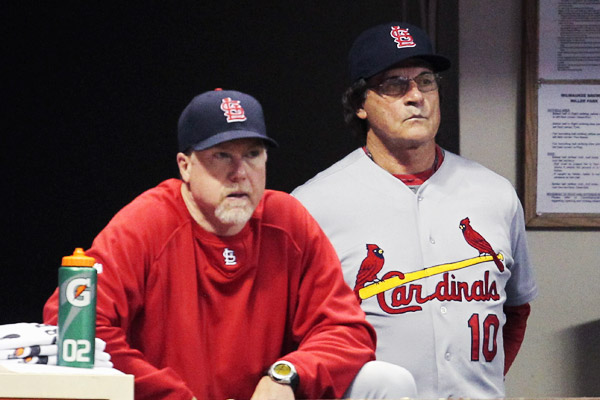
As Tony LaRussa walks away from a Hall of Fame career as a baseball manager, it's hard to argue with his methods that led to so much success for his players, both on and off the field.

Tim Keown of ESPN.com looks back on the career of Tony LaRussa.

There's a certain poetic justice to Tony La Russa's decision to retire after winning the World Series with a team that had no business winning one. There aren't many gaps in the man's résumé, but his third title filled one. He won when he should have won (1989), he lost when he should have won ('88 and '90), and now he's decided to walk away after a season in which he won the World Series in the most improbable manner. You could say 2011 cemented a legacy that dried and hardened years ago.

If you're looking to view the past 33 years of Major League Baseball through the eyes of one man, La Russa is the perfect tour guide. His old-school sensibilities (don't cross the man and expect it to be forgotten -- ever) meshed with the new-world thought processes to produce a dugout professor of Scholarly Medievalism.

He was a stat guy without being all wonky about it, redefining bullpen use in the late-1980s with a typically detailed, nearly compulsive precision. It was Gene Nelson for all or part of the eighth, Rick Honeycutt for a lefty or two and Dennis Eckersley to finish.

La Russa was willing to attempt the unconventional -- in some cases, the antithetical -- to get more out of his roster. Hitting the pitcher eighth in the lineup is destined to become the hallmark of his tradition-tweaking, but I'll fondly remember the "pod system" he briefly employed with a seriously flawed Oakland pitching staff in the mid-'90s. Instead of designating a starting pitcher, La Russa designated three pitchers for each game with the intention of coaxing three innings out of each. It didn't work, and it didn't last -- Doug Johns, John Wasdin and Ariel Prieto had something to do with that -- but it exemplified La Russa's congenital inability to fail conventionally.

And, before we get too sentimental, he presided over an Oakland team that became a traveling pharmaceutical show. He came away from that relatively unscathed, professing to know nothing and rarely being pressed. Like the commissioner and everyone else who was not directly implicated, La Russa escaped baseball's Great Drug War with a shrug and a how-was-I-supposed-to-know? After all, nobody expected him to join Mark McGwire and Jose Canseco in one of the dugout bathroom stalls. It was probably cramped with the two of them.

Which brings up another of La Russa's qualities: intense loyalty. (In fact, when discussing La Russa's qualities, it's understood that intense is the adjective of choice.) McGwire is the most obvious example. La Russa shepherded McGwire's public reintroduction, and it's not an exaggeration to assume that his prodding changed the man's life. Five years ago, it seemed unlikely that McGwire would ever appear in public. Now it's entirely possible he could end up working for another manager, in St. Louis or elswhere. That's nothing short of remarkable, and it has a lot to do with La Russa.

There's no doubt that La Russa could transition upstairs to the general manager's office if he felt the urge. Back before blogs and Twitter made instant news the scourge of baseball writing, La Russa's inside-baseball conversations became legendary among beat writers. His legacy exceeded the margins of the field.