Wednesday, June 8, 2011

Five Things From Canada


In the aftermath of the USA's clinical treatment of Canada in the opening night of Group C, we look at five things to carry forward into the second set of games on the Gold Cup schedule.

Multiple Choice: The United States was calm, collected, and dangerous on first looks. It was the second and third looks letting them down, turning into a panic matched only by the Canadian defenders. A bit more poise and winning time to consider options, and they're likely in the lead a lot earlier. Instead, shot selection went out the window in place of simply putting the ball somewhere near frame. It can work, but the US is too good a team to rely on that style of soccer. Their second goal demonstrated what the US should be doing in those situations, and it's to this team's credit that they made the appropriate adjustments.


Clean Up: There should be no complaints directed at the US defense from Tuesday night's performance. Steve Cherundolo, Carlos Bocanegra, Tim Ream, and Clarence Goodson did their jobs. The Canadian attack had its moments, but not what's expected from a team with Dwayne De Rosario and Ali Gerba. Canada can expect better against other teams in Group C, but the US back line wasn't giving enough away for Canada to have much of an opportunity of turning a half chance into a goal.

The Canadian Question: After tonight's as close to Canada as possible rivalry game, the Canadian Soccer Association is once again left to wonder what's happening with their program. Almost was moments like '07 aside, they have to find a way to develop and recruit players to compete at CONCACAF level. Right now, there are just too many gaps to fill. They're also combating a long term image problem with players that have options to represent another country more than likely to take it. Canadian MLS teams might not be the answer, but the CSA had literally two decades to come up with something better between the end of the North American Soccer League and MLS expanding to Canada. Remember when they were going to form a league made up of reserve teams from European clubs?

Group C: Scouting the rest of the group, it's tough to come up with a reason for the US to lose any games. Guadeloupe is an unknown quantity that usually catches someone, but their big game performance might've already happened. It wasn't enough to get a point, and that could be their swansong in 2011. Panama is a competitive CONCACAF team, but there's enough of a gap between then and the United States to favor the US in just about any scenario.

The Rest Of The Field: As we head into the second games, the winners across the groups make sense. Though few should've seen the multi-goal onslaughts coming in both Group A games and one of the Group B openers, the results were to be expected. That includes the 0-0 draw between Honduras and Guatemala in Group B. That's the group with the most to show in their second matchday, with Jamaica likely overmatched against Honduras and Guatemala set to show that Grenada is simply overmatched by the rest of the group. With El Salvador crashing out against Mexico, they don't look up to a return to form against Costa Rica. Group A will probably have to wait until matchday three to give us a game, the Mexico - Costa Rica showdown.

CONCACAF Gold Cup - USA 2 - Canada 0

The United States opened their 2011 Gold Cup campaign with a 2-0 Group C win over Canada at Detroit's Ford Field in front of 28,209 fans. A 15th minute goal from Jozy Altidore opened the scoring with Landon Donovan picking up the assist. Clint Dempsey made it 2-0 USA in the 62nd minute, with Altidore assisting. Tim Howard needed to make several saves late in the game to preserve the shutout.

“The last couple of days around the hotel and on the training ground... the atmosphere was really good in the hotel, training was really upbeat," Howard said. "We got into the dressing room early and there was a toughness about us that we were ready for this game. There was no hangover. We’re in a weird situation in CONCACAF because we play a lot of top teams around the world, and we’re hunting them all the time. Then you come into CONCACAF and, for better or worse, we’re the hunted. It takes on a different mindset and I think equally you have to be hard, you have to be tough and you can’t take anything for granted. Tonight our mindset was right.”

Also in Group C on Tuesday, Panama beat a 10-man Guadeloupe 3-2 in the early game at Ford Field. Guadeloupe trailed 2-0 when Mickael Tacalfred was sent off in the 37th minute and were down 3-0 before getting on the board in the 64th minute when Brice Jovial scored. Jovial would get a second shorthanded goal in the 78th minute.

Monday, June 6, 2011

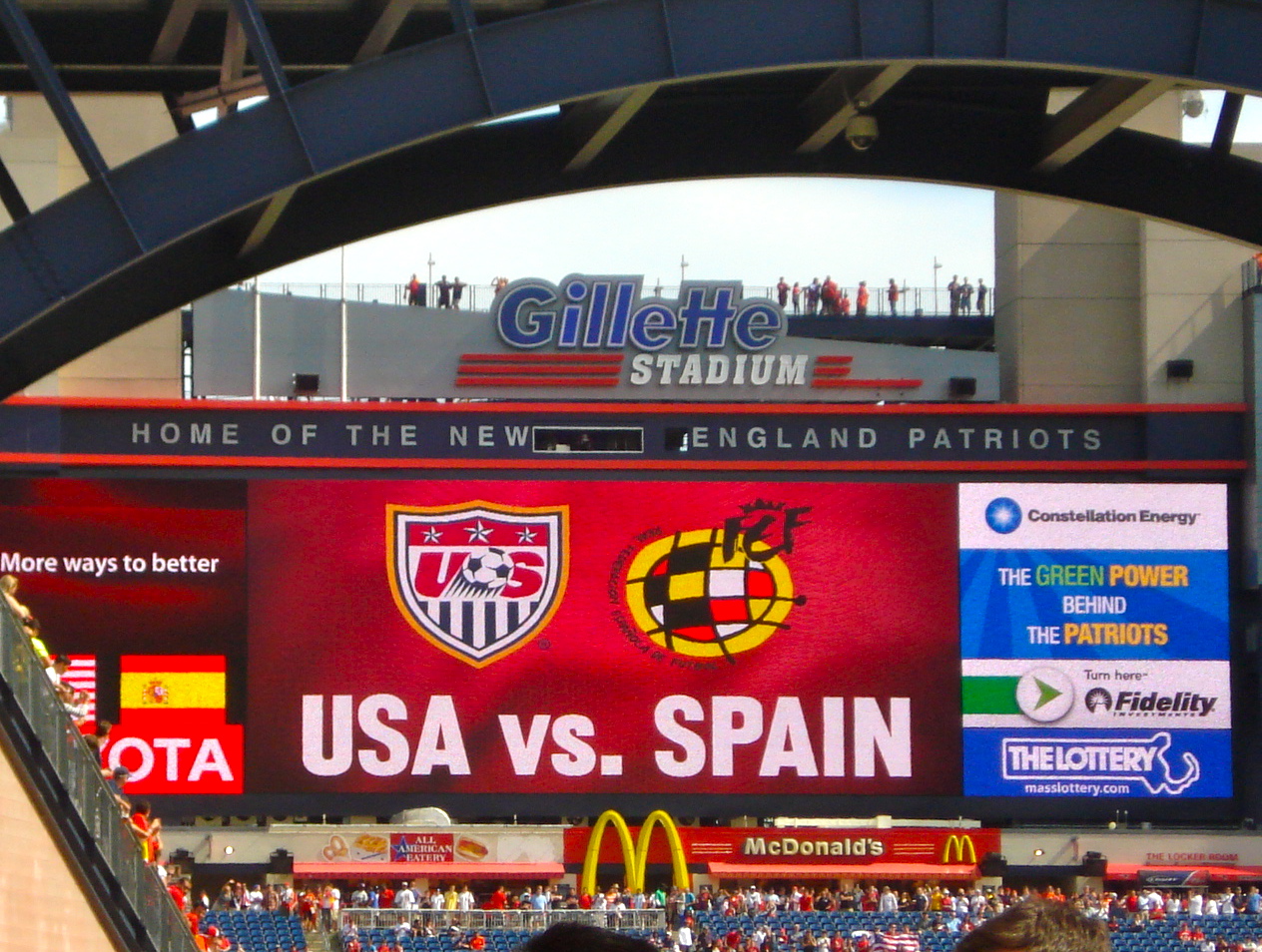
USA 0 – Spain 4

On a tough afternoon for US soccer supporters, the United States lost 4-0 to Spain in front of over 64,000 fans at Gillette Stadium in Foxborough, Massachusetts. The United States started a mix of veterans and squad players against an equally experimental Spain. Without Landon Donovan (illness) or Carlos Bocanegra (rested), US coach Bob Bradley opted to leave regulars Michael Bradley, Steve Cherundolo, and Clint Dempsey on the bench.

As expected, Spain had the better attacking play, stringing together passes and creating opportunities. Santiago Cazorla opened the scoring in the 28th minute, capping several near misses by Spain. Xabi Alonso found Alvaro Negredo to make it 2-0 Spain four minutes later. It was 3-0 Spain in the 41st when Cazorla scored again, this time from a rebound. Fernando Torres made it 4-0 in the 73rd minute, sending in a shot that bounced off both posts before crossing the goal line.

Uncharacteristically, Bradley subbed on five players at halftime, bringing on Bradley, Cherundolo, and Dempsey along with Clarence Goodson and Chris Wondolowski. Bradley later subbed on Alejandro Bedoya, using all of his available field players. Spain also used all six of their substitutions, bringing on regular starting keeper Iker Casillas in the 77th minute.

Earlier in the day, Cobi Jones, Earnie Stewart, and Eddie Pope were officially inducted into the National Soccer Hall of Fame. Joining the three Player inductees were Veteran Bruce Murry and Builder Bob Gansler. The five new members of the Hall of Fame were introduced before the start of the game.

Are Barcelona the greatest ever?

In the wake of Barcelona's 3-1 UEFA Champions League championship victory over Manchester United, the debate has begun about where Barca sits among the greatest club sides of all-time.

Do Barca’s players, with their poetic ball skills and precise attacking, surpass the best football teams of all time?

Jimmy Burns of Newsweek writes about where Barcelona sits among soccer's elite.

Some think this would suggest that Barca is certainly better than United’s own best team of the 1998–99 season, which became the first English side to win a treble of trophies (Premier League, FA Cup, and Champions League) with a roster that included an evolving young star named David Beckham.

For lovers of the “beautiful game,” Barca’s onslaught against Manchester United was soccer played at its best, with huge skill and minimum thuggery. The focus of Barcelona’s play was on possession of the ball (or on winning it back during the rare moments it was lost), then attacking with an intricate choreography of precise, short passes where players moved on and off the ball in constant, fluid movement. In the words of Simon Barnes, chief sports writer at the London Times, “all soccer people turned instantly into ballet critics to applaud a style of play that had an aesthetic dimension as well as being admirably, if not lethally, suited for the purpose of attaining victory.”

Barcelona should be model for how soccer is best played

MIKE JACOBS COLUMN, Evansville Courier Press, June 4, 2011

Those who watched Barcelona defeat Manchester United in the UEFA Champions League final last weekend were able to witness the potential of a soccer revolution here in the United States.

According to figures compiled by Nielsen Media Research, as reported by Soccer America, the telecasts of the game delivered a 2.1 rating and 6 share, which represents 4.2 million viewers nationally. That share is the percentage of U.S. households with televisions that were tuned to the game, and doesn't include restaurants and bars that might have been tuned in as well.

Those statistics, which are generally larger than Major League Baseball averages on the same day and time slot, again show that soccer is now a mainstream sport in the United States.

Still, the tremendous TV ratings and attendance at exhibition games generally have come when the top European and South American teams are participating. So the next step as a soccer nation is for us to be able to replicate those ratings and attendance figures with American players and teams in Major League Soccer.

The revolution that I mentioned could reference soccer as a spectator sport here in the United States. But this soccer transformation will truly be felt on the field and is due to the performance of Barcelona.

As a Manchester United supporter, it was humbling to see the team get handled so clinically. Barcelona's 3-1 victory was a convincing defeat of its English opposition, but it wasn't just on the scoreboard that a huge victory was displayed. How Barcelona defeated Manchester United is what will spark this change in the modern game, both in the United States and abroad, as well as potentially in other sports as well.

Here are key points that were illustrated by Barcelona, and could be adopted by young athletes in all sports in the United States-

* Piano Players versus Piano Carriers: I had once believed that great teams had a balance of creative artists (piano players) and hard workers (piano carriers). What made Barcelona so unique was that their most creative players were also the ones who displayed the most blue-collar qualities.

Xavi Hernandez is considered the best passing midfielder in the world today, and not only did he lead Barcelona with the most total passes (148) and completion percentage (95), he also covered more ground than any other player on the field. Xavi's 7.4 miles covered in the 90-minute game dwarfed any of the players on Manchester United.

When your best players are also your hardest workers, you know that you have special components. At Barcelona, their top players are both piano players and piano carriers.

* The best defense is a good offense: This phrase is used often in military and sport, and was evident in the UEFA Champions League final. Barcelona's movement of the ball and player movement away from the ball is a standard that every player and team should emulate.

As a team, Barcelona's 777 completed passes more than doubled the passes Manchester United made (357), with Barcelona retaining the overall possession for 69 percent of the game. When your team has the ball for more than two-thirds of the game, it is hard for the opponent to mount an attack. When your team is forced to chase and defend for long stretches, it is hard to compose yourself to create any counter-attack when, on the rare occasion, you do win the ball.

* Transition defense: As much is made of Barcelona's ability to retain possession, their most underrated attribute is their ability to defend in transition. Great teams in all sports take a level of ownership in defensive transition — winning the ball back immediately after your team loses possession. In this case, Barcelona is the best team in the world at defensive transition with the ability to put the opposition under pressure immediately after losing possession.

The combination of Xavi, Iniesta and Sergio Busquets in the midfield closes the ball down and pressures the opposing midfield quickly to create turnovers and turn them into scoring chances. Barcelona's third goal was a brilliant finish by David Villa, but it all started with Busquets dispossessing Manchester United midfielder Nani deep in his own defensive third.

* Does size matter? Strength and toughness are not measured in feet and inches, but rather in the way a player conducts himself. Barcelona has three of the world's greatest players in Lionel Messi (5-foot-6), Xavi (5-7) and Andres Iniesta (5-7). When your game is built around keeping the ball on the floor, quick movement and defensive pressure, perhaps athletic success is less about how big you are, and more about how big you play.

Whether by high technical quality or ability to retain possession when their team has the ball, or their ability to win the ball back so quickly when the other team has the ball, Barcelona has created a new blueprint for youth players and teams all over the world to follow.

Thursday, June 2, 2011

FSC’s Soccer Night in America Has Just One Flaw

Zac Wassink of Yahoo Sports writes of what's wrong with the Fox Soccer Channel's Soccer Night in America.

There's an old Boy Meets World episode where Cory surprises Topanga while the latter is babysitting. The young boy being babysat eventually introduces himself to Cory, and explains that he would like to stay up until 9:30 to watch his favorite show. A confused Cory doesn't understand why "they," the television executives for that particular network, would move the show from it's original 8:30 time slot to 9:30. The very upset young boy responds "they're trying to kill it! They're trying to kill it!" This was, of course, an inside joke regarding ABC's treatment of the Boy Meets World series.

The joke also kinda/sorta works for FOX Soccer Channel's Soccer Night in America.

What FSC and/or MLS failed to remember when creating the Soccer Night In America schedule is that there is no sect of people lazier than American television viewers. We can't be bothered to get up and walk a few feet to turn our TVs on or change the channel or volume. We don't even need to bother reading TV listings in the paper, a TV Guide or the scrolling channel guide TV station. Those of us with digital cable or satellite boxes can simply press an arrow button on our remote to see what's going to be on different stations over the next 24-48 hours, and even read a short description for every show by pressing an "Info" button. Technology's great.

My simple point is that not every TV viewer that watches sports in this country is a diehard fan. The casual sports fan may not know which teams are playing, but he does know that if he puts his TV on ESPN at 8 pm during the summer, a baseball game will be on. He knows that some football game will be on FOX and/or CBS during a fall Sunday afternoon, NBC during that evening and ESPN the following night. How does he have such knowledge? Because he's been programmed to know this information through years of repetitious television viewing.

That's not going to happen with FOX Soccer Channel and Soccer Night in America, however, due to games being scheduled at all kinds of different times throughout the summer. The June 3 pre-game show begins at 10:30 pm. Seven days later, coverage starts off at 8 pm. Such time changes occur throughout the season, and broad commercials for the Soccer Night in America program (at least commercials broadcast in NY/NJ and PA) tell viewers to "check local listings."

No casual sports fan in this country that wasn't going to watch the show in the first place is "checking local listings" or putting in any such effort to watch soccer. Not a one.

FSC's Soccer Night in America isn't about getting me or similar MLS and soccer fans to watch. Chances are, we're going to somehow learn whenever any live soccer match is shown on FSC and FSPlus and, at the very least, check the score of the game at least once. Soccer Night in America is a real opportunity to establish a true TV soccer tradition in the United States. When such a tradition is established, viewers may not know which teams are playing on a particular night, but they'll know that if their TVs are on FSC at 8 pm on Saturday, a live soccer match, one that's probably featuring Major League Soccer clubs, will be on.

MLS fanboys hurt by any criticism of the league will tell you that such a set schedule for Soccer Night in America is impossible due to the west coast teams in the league. West coast teams are featured in Sunday Night/Monday Night Football broadcasts and Sunday Night Baseball showings throughout the season. Changes are made to team schedules to accommodate TV. Major League Soccer has already done this with Soccer Night in America. The Red Bulls vs. New England match originally scheduled for June 11 was moved to June 10 specifically for Soccer Night in America . No biggie.

The point of having a Soccer Night in America show is to have an actual "soccer night" in America, a night each week that, as time goes on, has more and more viewers watching and enjoying the sport. SNIA has, thus far, been a fine television program and I look forward to more of it throughout the season. Next year, though, pick a night and a time and stick with it.

And give the program a better theme. The old BCS theme just isn't doing it for me.

Wednesday, June 1, 2011

Numbers don't lie when looking at Barca


More stats on what makes Bareclona so special, as drawn from the UEFA Champions League final (courtesy of NSCAA CEO Joe Cummings and Opta).

The difference between Barcelona and Manchester United was clear to see during the Champions League final, as Lionel Messi inspired Pep Guardiola's side to a 3-1 victory.

But the collective effort of the Catalan team was crucial in constructing the win, demonstrated by the following statistics courtesy of Opta.

777 - Total number of passes that Barcelona made in the final, more than double Manchester United's 357. Barca had 69% of overall ball possession.

148 - Passes that Spanish midfielder Xavi completed during the game, a high for the Champions League this season. He misplaced only seven, giving him a completion rate of 95%.

90 - Percentage of passes completed by the Barcelona team. United's was 80%.

60 - Passes between Xavi and Andres Iniesta, the most common pass journey on the pitch. United's most frequent combination was between defender Rio Ferdinand and Nemanja Vidic (16).

55 - Number of times Xavi and Iniesta passed to Messi.

18 - Passes made by Barcelona keeper Victor Valdes - two more than Manchester United striker Javier Hernandez.

16 - Times United fouled Barcelona's players. Barcelona did likewise to their opponents on only five occasions.

15 - Dribbles by Messi, of which 10 were successful. Wayne Rooney was the next most frequent dribbler with six.

12 - Shots on target by Barcelona. Messi and Iniesta had three of these each.

11.95 - According to Uefa, distance in kilometres covered by Xavi, the highest in the Barcelona team. Ryan Giggs covered the greatest distance by a United player (11.16km).

1 - Number of shots that Manchester United had on target. This was Rooney's 34th-minute goal.